A large relevant sample size of data is considered Fact when analyzed.
Posted on: April 19, 2026
A Multidisciplinary Approach to Thinking?
Peter D. Kaufman is one of the most successful businessmen of our time, and yet few people have ever heard of him.
He’s the CEO of Glen air, an aerospace company based in California, and the editor of Poor Charlie’s Almanack, a book about Charlie Munger.
A statistician’s best friend is a large, relevant sample size. And why? Because a principle derived from a large, relevant sample size can’t be wrong, can it? The only way it could be wrong is if the sample size is too small or the sample itself is not relevant.
The three buckets of relevant sample sizes.are:
Number one is 13.7 billion years. Is that a large sample? It’s the largest one in the whole universe. There is no larger sample. It’s the inorganic universe. Physics. Geology. Anything that’s not living goes in my bucket number one: 13.7 billion years.
Bucket number 2 is 3.5 billion years. It’s biology on the planet Earth. We’re biological creatures.
And number three bucket is 20,000 years of recorded human history. That’s the most relevant of all. That’s our story. That’s who we are.
So we’re going to take a couple of examples here of multidisciplinary thinking. We’ll ask this question: is there a simple two-word description that accurately describes how everything in the world works?
So we go to bucket number one. How does everything work? We go to Newton’s Third Law of Motion.
We’re getting very multidisciplinary here. “For every action, there will always be an equal and opposite reaction.”) He wins one of my pens here for answering that question correctly. I always give out rewards. It’s like operant conditioning from psychology, right?
If I put this bottle of water on this table, Newton’s Third Law of Motion says that if the bottle pushes down on the table with “force x,” and it also strangely says that the table pushes back with equal “force x.” That’s very strange.
But you know how long that’s been true? 13.7 billion years, that’s been true.
What if I push down twice as hard, what does the table do? Well, if I push down twenty-one and a half times as hard? What does the table do? There is a good word, a catchall word to describe what we’re talking about here when this pushes down and this thing pushes back? It’s reciprocation. But it’s not mere reciprocation. It’s perfectly mirrored reciprocation.
The harder I push, the harder it pushes back. Does everybody buy that? That’s bucket number one. That’s how the world works. It’s mirrored reciprocation. Everything in the inorganic universe works that way.
We go to bucket number two.
I’m going to introduce a little humor into this.
Pretend you are catching cat. Mark Twain said that a man who picks up a cat by its tail will learn a lesson he can learn in no other way. What is this cat going to try to do? It’s going to do what? (Answer: “Attack you.”)
It’s going to try and scratch me with its sharp claws. And why? It doesn’t find being picked up by its tail very agreeable, does it? What if I start swinging this cat around by its tail—what does the cat do now? Now it’s trying to scratch my eyes out. It said, “You escalated on me pal, I’m going to escalate back on you.” Does that sound a lot like mirrored reciprocation?
But what if instead of doing something disagreeable with this cat, we do something very agreeable with this cat?
And this cat’s sitting here, and we come over and we gently pick it up by its tummy and we put it in the crook of our elbow and we gently stroke it. Does the cat try and scratch us? What does it do? It licks our hands.

And as long as I sit here and stroke it, it’s going to continue to try and lick my hand.
It wants to show me what? “I like this. This is agreeable. You’re a good guy. Keep it up, man!”
It is mirrored reciprocation, isn’t it? If I act in a disagreeable way to the cat, the cat acts in a disagreeable way back, and mirrored. If I act in an agreeable way, what do you think we’re going to find when we go to bucket number three? It’s exactly the same thing, isn’t it? Your entire life.
Every interaction you have with another human being is merely mirrored reciprocation. You’re going to say to yourself, “This is too simple. It can’t be this simple.” It is this simple! It doesn’t mean it’s not sophisticated.
This is a very sophisticated model we just derived, isn’t it?
We did it in a multidisciplinary fashion, didn’t we? We looked into the three largest sample sizes that exist, the three most relevant, and they all said exactly the same thing. Do you think we can bank on that? 100 percent we can bank on that.
So, if you think about things being complex as being sophisticated like most people do, you think the more complex it is, the more sophisticated it is.
Albert Einstein once listed what he said were the five ascending levels of cognitive prowess.
Now there’s nobody in this room that doesn’t want to be level number one. Right? That’s why we’re here.
You don’t want to be level number five. You want to be level number one. Wait until you hear what these levels are, it’s going to blow your mind.
Number five he said, at the very bottom, was smart.
That’s the lowest level of cognitive prowess is being smart. The next level up, level four, is intelligent.
Level three, next up, is brilliant. Next level up, level two, he said is genius.
What’s higher than genius? He must have that backward.
Number one level for Albert Einstein is simple. Simple transcends genius.
Why the right kind of simple, better than genius? Because you can understand it! I bought this book—I usually take it when I’m giving a talk like this. It’s the Ethics by Spinoza.
Spinoza’s ethics book was written by a true genius. And guess what? You can’t understand anything in it.
But can you understand what I walked you through—mirrored reciprocation?
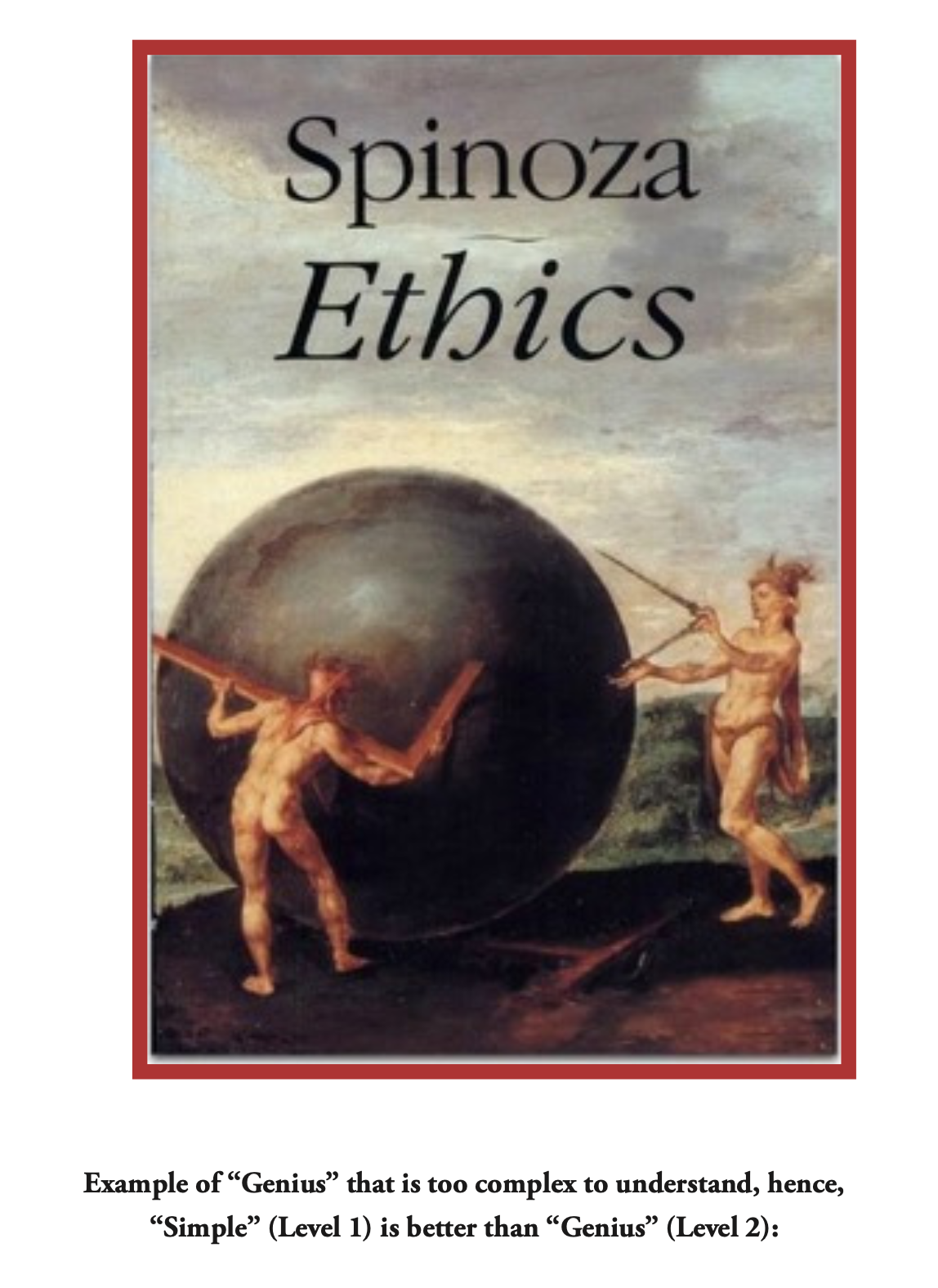
Because this is an economics club, right, everybody here is interested in economics.
Let’s give an example of a model derived, multidisciplinary, same way we did before, but is just about as pure an economic model as you can find.
We’re going to ask the question, what’s the most powerful force that we as human beings, both as individuals and groups, can potentially harness towards achieving our ends in life?
We go to bucket number one. We ask, what’s the most powerful force in bucket number one? I’m going to quote Albert Einstein again. He said, “The most powerful force in the universe is compound interest.”
He not only said that it’s the most powerful force in the universe, he said it’s the greatest mathematical discovery of all time.
He said it’s the eighth wonder of the world.
And he said that those who understand it get paid by it and those who don’t pay for it.
What’s a good working definition of compound interest? I will propose one. You can have your own, but this is mine. I say compound interest is dogged incremental constant progress over a very long time frame. Is that a fair definition?
I think that’s the answer from bucket number one.
We go to bucket number two. 3.5 billion years of biology. What’s the most powerful force in 3.5 billion years of biology?
It’s the machine of evolution. How does it work? Dogged incremental constant progress over a long time frame. This is the beauty of deriving things multidisciplinary. You can’t be wrong! You see these things lined up there like three bars on a slot machine. Boy, do you hit the jackpot.
What do you think we’re going to find when we go to bucket number three?
20,000 years of human experience on earth.
You want to win a gold medal in the Olympics. You want to learn a musical instrument. You want to learn a foreign language. You want to build Berkshire Hathaway. What’s the formula?
Dogged incremental constant progress over a very longtime frame. Look how simple this is. This is above genius.
It’s absolutely above genius because you can understand it. This isn’t somebody drawing all these formulas and things up here about how numbers multiply and amplify over time.
The problem that human beings have is we don’t like to be constant. Think of each one of those terms. Dogged incremental constant progress over a very long time frame. Nobody wants to be constant.
We’re the functional equivalent of Sisyphus pushing his boulder up the mountain. You push it up halfway, and you go, “Aw, I’ll come back and do this another time.” It goes back down. “I’ve got this great idea, I’m going to really work hard on it.”
You push it up halfway and, “Aw, you know, I’ll get back to this next month.” This is the human condition.
In geometric terms this is called variance drain. Whenever you interrupt the constant increase above a certain level of threshold, you lose compounding, you’re no longer on the log curve.
You fall back onto a linear curve or a step curve down. You have to be constant. How many people do you know that are constant in what they do? I know a couple. Warren Buffett and Charlie Munger.
Everybody wants to be rich like Warren Buffett and Charlie Munger. I’m telling you how they got rich. They were constant. They were not intermittent.
Let me give you an example of why intermittency is perhaps the most important thing in your lives, whether you realize it or not. We’ll begin with the example of bringing home a puppy from the pet shop.
Brand-spanking-new puppy from the pet shop. And the kids are so excited, they’re so excited. What’s your goal of bringing home this puppy to your household? I say it’s to have an engaged, contributing, all-in new member of your household.
And night number one, how are we doing? It’s a disaster. This thing’s over in the corner shaking like a leaf. It’s anything but engaged. It’s anything but contributing and it’s anything but all in. It’s shaking like a leaf. Human beings are really good at solving this problem. We know we need to create a calm, reassuring, secure, and safe environment.
We know that even though this puppy can’t understand what we’re saying, we need to communicate in soothing tones.
And we also know that we need to provide food and water for this puppy. But underlying all these things, stitching them all together, we really know we have to be constant, don’t we?
You can’t not feed the puppy one day, or what happens? Well, the puppy freaks out. The puppy becomes a neurotic puppy. It doesn’t know whether it can trust you or not. This trust that this puppy needs to go all in is dependent upon you being constant in these behaviors.
Does everybody accept that? So, if we are constant, usually in about seven days more or less, if we are constant, this little puppy will trot over to our side and it will attach itself to us. And for the rest of its life, it will be willing to die for us.
That puppy just went all in, didn’t it? Now, did it go all in because it’s our idea that we want an engaged, contributing, all-in new member of our household? It doesn’t even know what our idea is, does it? Why did it just go all in? It was the puppy’s idea!
Now let me tie this to your lives. I did this at Google and they really couldn’t figure out what I was doing. And then afterwards they said, “You know, that was really good. Your eight-dollar crystal ball, that’s really a good trick.”
So I’ll do my eight-dollar crystal ball trick. And I told them I had rows bigger than this one, full of the smartest people in the world. And I said, “Guess what I’m going to do with my eight-dollar crystal ball?” I said, “I’m going to do a psychic reading of anybody in this room. Anybody.”
And I said to Google, “If you think that I’ve got a stooge in the room where I’ve got this prearranged, I don’t. Go out in the corridor and bring somebody in. I’ll do the psychic reading.”
This eight dollars I spent on Amazon is the best money I ever spent. So I’m going to select you. What’s your name? (Answer: “Emily”) We’re going to take Emily, we’re going to do a psychic reading of Emily right in front of you.
You’re not going to believe this. I’m going to nail this. You’re all going, “This guy’s a nutcase.” Spencer’s going, “Man, why did I invite this guy?” Just be patient, Spencer, this is good stuff. I’ll pull it off. So I’m going to tell Emily what she’s been looking for her whole life.
Is there anybody here who thinks I can do this? Well, wait until you hear my answer, and then for the rest of your life, you’re all going to go, “I know what everybody in the world is looking for.”
Emily, your entire life you’ve been on a quest, an odyssey, a search for that individual that you can 100 percent absolutely and completely trust. But who’s not just trustworthy, but principled, and courageous, and competent, and kind, and loyal, and understanding, and forgiving, and unselfish.
I’m right, aren’t I? (Answer: “Dead on.”) You know what else my eight-dollar crystal ball tells me? If you ever think you may have encountered this person, you are going to probe and probe and test and test to make sure that they are real, that you’re not being fooled.
And the paradox is that it looks like you’re probing for weakness, but you’re not. You’re probing for strength. And the worst day of your life is if instead of strength, you get back weakness.
And now you feel betrayed. You know why? You’ve got to start your search all over again. It’s the worst thing in the whole world, isn’t it? Does everybody here agree with me on this? Look how simple this is.
Here’s your twenty-two-second course in leadership. That’s all it takes.
You don’t have to go to business school. You don’t need books. You don’t need guest speakers. All you have to do is take that list that’s in Emily’s head, and every single other person in this room, every single other person in the whole world, has this list in their head—trustworthy, principled, courageous, competent, loyal, kind, understanding, forgiving, unselfish—and in every single one of your interactions with others, be the list!
Remember how that puppy went all in? You do this with the other human beings you encounter in life. They’re all going all in, and not because it’s your idea.
Most people spend all day long trying to get other people to like them. They do it wrong. You do this list, you won’t be able to keep the people away.
Everybody’s going to want to attach to you. And be willing to do what? Just like the puppy, they’d be willing to die for you. Because you are what they’ve been looking for their whole lives. This is pretty profound, isn’t it?

 Adonis Diaries
Leave a comment